Key takeaways
- Prospective clients often call several firms and hire the first one that engages.
- A traditional answering service takes messages. An AI receptionist runs your intake.
- Compare on four things: intake quality, booking, follow-up and cost per qualified consult.
- The best setup keeps humans in charge of judgment and lets AI handle speed and consistency.
The intake problem every firm has
Legal problems don't wait for business hours. Someone is rear-ended on a Friday night, served papers on a Saturday or arrested at 2 AM. They search, find a few firms and start calling. The firm that answers, listens and books a time to talk usually gets the case.
Meanwhile, attorneys are in court, in depositions or with clients, and the front desk can only take one call at a time. That gap between when people call and when someone can talk to them is where cases get lost.
What a traditional answering service does
A live answering service picks up, takes a name, number and short message, and emails or texts it to the firm. Some offer basic scripts. It's better than voicemail, but the caller still hangs up without a real answer. Someone at the firm has to call back, and by then the prospect may have already booked with another firm.
What an AI receptionist does differently
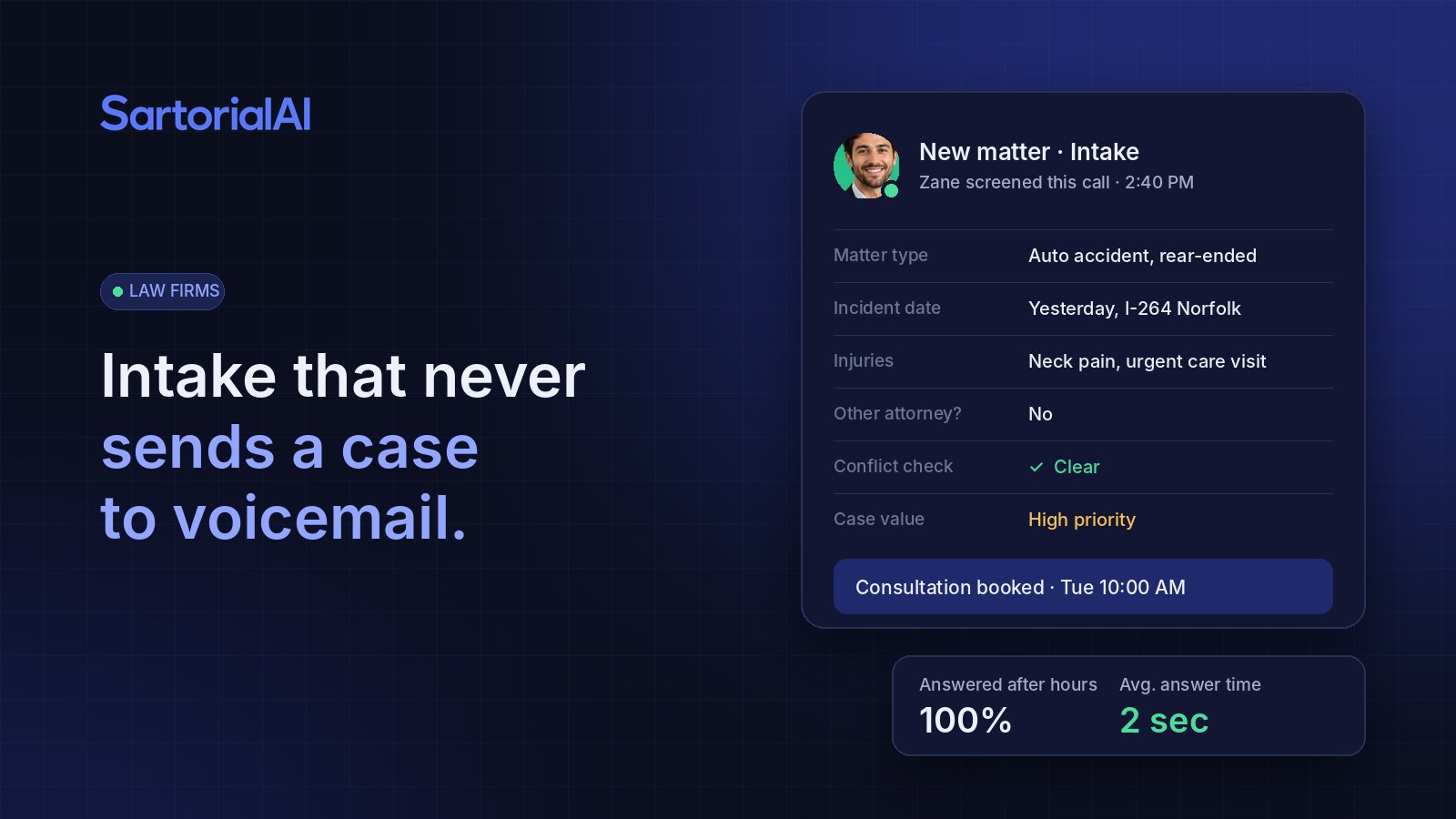
An AI receptionist runs your actual intake. It asks the questions you'd ask: what happened, when, where, who else was involved, whether they've talked to another attorney. It can flag possible conflicts, screen out matters you don't handle and identify high-value cases.
Then it books the consultation into an attorney's real calendar, sends a confirmation and reminder, and gives the firm a clean summary. If the prospect doesn't book, a follow-up agent checks back by text and email so they don't go cold.
How to compare them
- Intake quality. Does it capture the facts you need to evaluate the matter, consistently, on every call?
- Booking. Can the caller leave with a consultation on the calendar, or just a promise of a callback?
- Follow-up. What happens to prospects who don't book on the first call?
- Coverage. Nights, weekends, holidays and overflow when three calls come in at once.
- Cost per qualified consult. Divide the monthly cost by the number of qualified consultations booked. That's the number that matters, not cost per minute.
What AI should and shouldn't do
An AI receptionist should never give legal advice, promise outcomes or decide whether to take a case. You set exactly what it can say. Its job is speed, consistency and logistics: answer immediately, gather facts the same way every time, book the time and hand a clear summary to a human who makes the call.
That division of labor is the point. Attorneys spend their time on judgment and relationships, and no prospect waits on hold or reaches voicemail.
Getting started
Start with your current intake form. Those questions become the AI's script. Add your practice areas, the matters you decline and your consultation availability, then make a few test calls with realistic scenarios. Most firms are live within 48 hours.
Try it on your own business
Start free and see SartorialAI answer, book and follow up for you. Live within 48 hours.